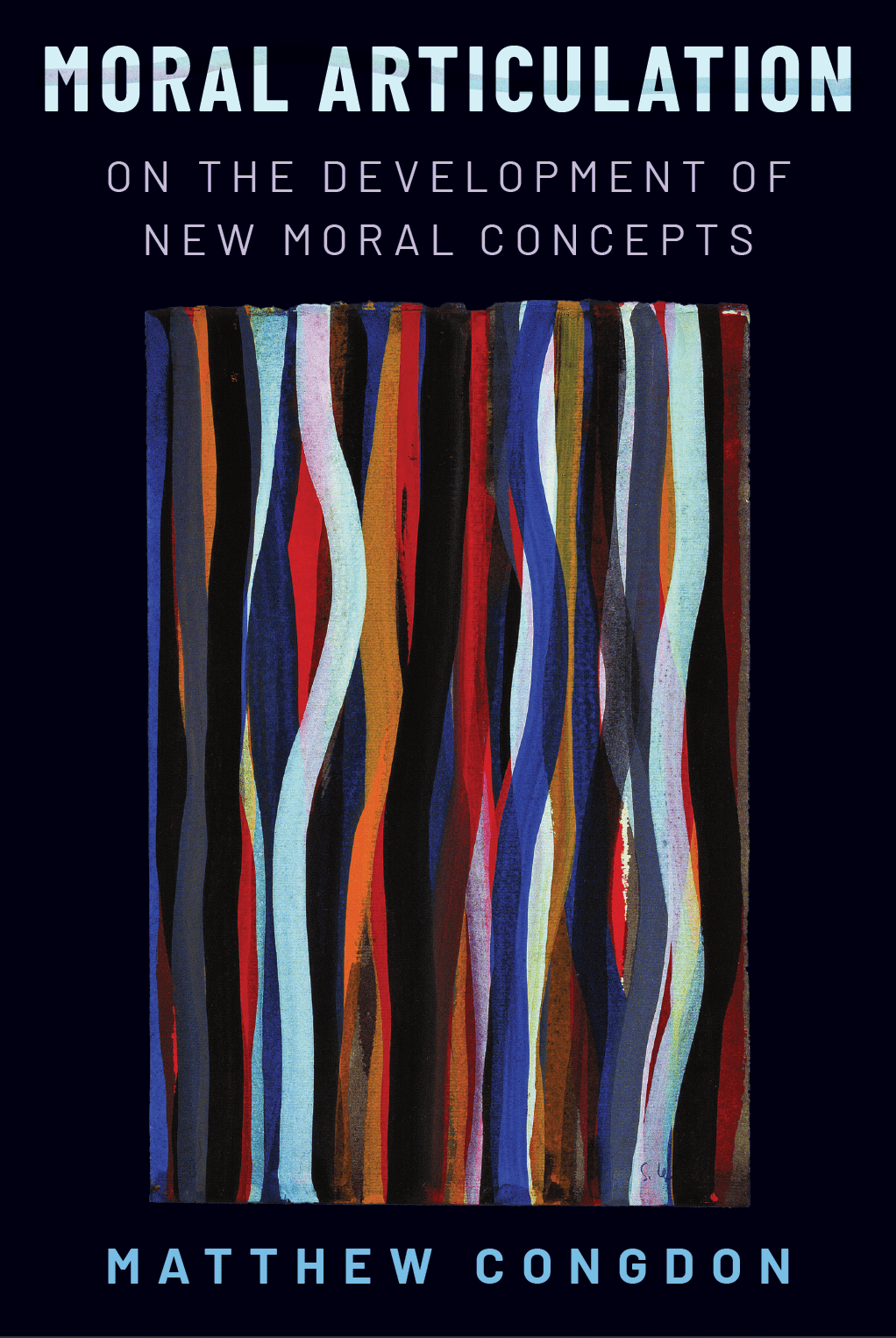
“By introducing the concept of articulation into the debate on moral epistemology, Matthew Congdon’s Moral Articulation manages to solve one of the pressing issues at stake: Where do new moral ideas come from? Overcoming the unsatisfactory alternatives between ‘inventing,’ ‘constructing,’ and ‘discovering’ them, it is the ongoing and strenuous process of ‘articulation’ that should give us a clue here. A pathbreaking contribution. Elegantly written and masterfully done, Moral Articulation is a wonderful read and a well needed proof that it takes the encompassing architecture of a monograph to make a real difference in philosophy.”
— Rahel Jaeggi, Professor of Social Philosophy and Political Philosophy, Humboldt University Berlin
“In this deftly crafted book, Matthew Congdon aims to combine a historicized conception of moral intelligibility with realism about moral value. The circle is squared in the idea of ‘moral articulation’–the act of being true to a phenomenon while also thereby shaping it. The result is a compelling new articulation of the possibilities of historically sensitive yet realist thinking in ethics.”
— Miranda Fricker, Julius Silver Professor of Philosophy, New York University
“How do moral concepts, such as racism, take on an authority over our thinking that they did not have before? In this fascinating study, Matthew Congdon strikes an illuminating balance of a kind of realism about the object of the concept with an account of how that concept nonetheless has a historical context in which it is grasped. This rich and sophisticated treatment takes our understanding to a new level, which will doubtless have a significant influence on how to characterise our moral thinking and its development over time.”
— Robert Stern, Professor of Philosophy, University of Sheffield
Moral Articulation: On the Development of New moral Concepts is available through OUP and Amazon, but you can also order a copy through your local bookstore and encourage your institution’s library to obtain a copy. It is also available in audiobook format.
You can hear me talk about the book on recent episodes of the podcasts Good is In the Details and The Iris Murdoch Podcast.
This book explores the historical development of new moral concepts. Starting from examples of new moral terms invented in the twentieth century, like ‘sexual harassment’, ‘genocide’, ‘racism’, and ‘hate speech’, this book asks: what we are doing when we bring ethically significant acts and events under new descriptions? Are we simply naming moral phenomena that already exist, fully formed and intact, prior to their expression in language? Or are moral phenomena sensitive to the descriptions under which they fall, such that new modes of moral expression can reshape the phenomena they bring to light?
Moral Articulation outlines an ethical framework that allows us to embrace a version of the latter, transformative view without sacrificing notions of moral truth, objectivity, and knowledge. The book presents a view of moral meaningfulness as extending beyond what we can presently put into words, urging that expansions in our moral vocabularies often begin in dissonant experiences of conceptual and linguistic limits. Resisting a tendency in contemporary ethics to start with situations and dilemmas whose descriptions are already given, this book argues that the struggle to piece together a discursively articulate picture of a situation is an ethical task in its own right. The result is a picture of ethical life that emphasizes the role of language in shaping who we are.
 Matthew Congdon